|
|
Last
Modified on
Aug 02, 2026
Most Louisiana successions do not need to become prolonged courtroom battles. When the will is valid, the heirs agree, and the succession representative properly administers the estate, the process may remain largely uncontested.
However, some disagreements cannot be resolved through routine filings or informal negotiations. Louisiana succession litigation provides a way to present evidence, protect estate property, and obtain an enforceable decision from the court.
Here are five situations in which succession litigation may become necessary.
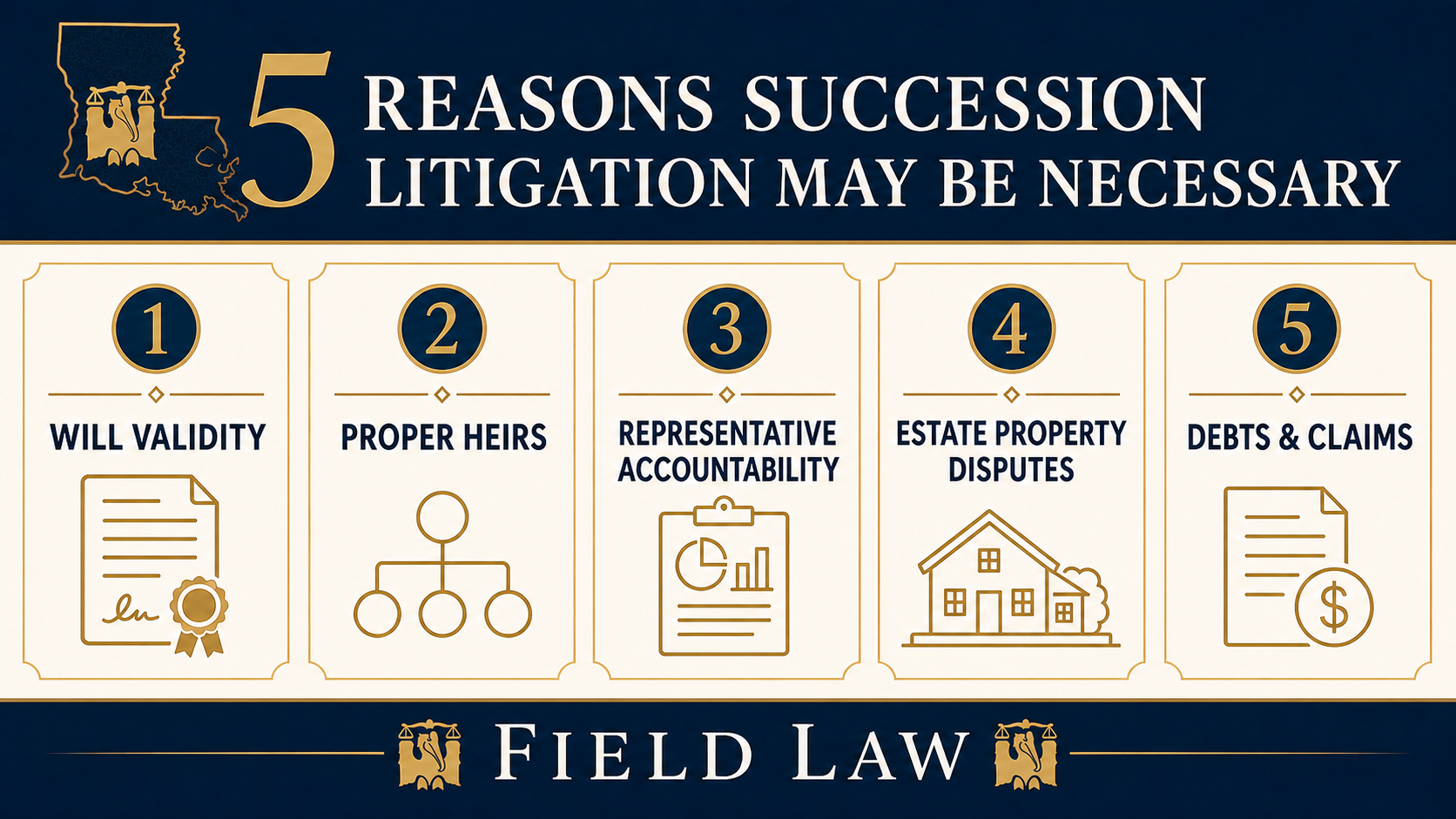
1. Determining whether a will is valid
A will controls the distribution of an estate only if it satisfies Louisiana law. Litigation may be necessary when an interested person has a legitimate reason to question:
- Whether the document satisfies Louisiana’s required testamentary formalities;
- Whether the testator signed or directed the execution of the will;
- Whether the testator possessed testamentary capacity;
- Whether someone procured the will through fraud, duress, or undue influence;
- Whether a later will revoked an earlier one; or
- Whether someone altered the document after it was signed.
Under Louisiana Civil Code Article 1477, a person making a testament must be able to comprehend generally the nature and consequences of the disposition. Meanwhile, Civil Code Article 1479 allows a court to invalidate a donation produced by influence that substituted someone else’s wishes for those of the person making the disposition.
A disappointed heir does not have grounds to contest a will merely because the result feels unfair. There must be a legally recognized basis supported by evidence. When that basis exists, litigation allows the court to determine whether the document should control the estate.
We discuss these issues more fully in What Happens When Families in Louisiana Question a Will?
2. Identifying the proper heirs and legatees
Before an estate can be distributed, the court must determine who is entitled to receive it.
When the decedent left a valid will, those recipients are generally called legatees. When the decedent died without a will, Louisiana’s intestacy rules determine the heirs. The answer can become complicated when the family includes:
- Children from different relationships;
- A surviving spouse and separate children;
- Alleged children whose filiation has not been legally established;
- Adopted children;
- Predeceased children and their descendants;
- Estranged relatives;
- Forced heirs; or
- Relatives who may have renounced or become disqualified from inheriting.
A filiation dispute can be especially significant because establishing—or failing to establish—a parent-child relationship may change who inherits the estate. Our article on filiation fights in Louisiana successions explains how those claims can affect an intestate estate.
Succession litigation gives the competing parties a formal process for presenting records, testimony, DNA evidence when legally appropriate, and other proof. The court can then identify the proper heirs or legatees before distributing the property.
3. Holding a succession representative accountable
A succession representative may be called an executor, administrator, or independent administrator, depending on the proceeding. Regardless of the title, that person does not own the estate property and cannot administer it solely for personal benefit.
Under Louisiana Code of Civil Procedure Article 3191, a succession representative is a fiduciary. The representative must collect, preserve, and manage succession property as a prudent administrator.
Litigation may become necessary when a representative:
- Fails to identify or safeguard estate assets;
- Uses estate property personally;
- Pays some heirs while ignoring others;
- Refuses to provide required information or accountings;
- Sells property for an improper purpose or inadequate price;
- Favors one beneficiary over another;
- Allows insurance, taxes, or necessary expenses to go unpaid;
- Ignores court orders; or
- Unreasonably delays closing the succession.
An interested person may ask the court to compel an accounting, prevent a proposed transaction, recover estate property, surcharge the representative for losses, or remove the representative. Code of Civil Procedure Article 3182 permits removal for reasons that include incapacity, mismanagement, and failure to perform a legal or court-ordered duty.
Our article What Can’t a Succession Representative Do? provides a closer look at these limitations.
4. Resolving disputes over estate property
Families do not always agree about what belongs to the estate or what should happen to it.
Common disputes involve:
- Whether property was community or separate property;
- Whether an account belonged to the decedent or passed directly to another person;
- Whether money transferred before death was a loan, donation, or unauthorized withdrawal;
- Whether the estate should sell or retain a house;
- Whether an heir must return property taken after the death;
- How a closely held business should be valued or managed;
- Whether the decedent actually owned a disputed LLC interest; or
- How estate expenses should be allocated.
These disagreements often involve more than sentimental attachment. A decision about ownership, classification, or value can substantially change each person’s inheritance.
Business interests and income-producing property can create additional problems because delay may damage the asset itself. Someone may need authority to operate the business, collect rents, preserve records, or prevent an improper transfer while the larger dispute remains pending. We address those concerns in What Happens When a Probate Fight Involves a Business, LLC, or Investment Property?
5. Resolving debts and competing claims before distribution
A succession is not ready for final distribution simply because the heirs agree about who should inherit. The estate may also have debts, expenses, tax obligations, reimbursement claims, or pending lawsuits.
A dispute may arise over:
- Whether an alleged debt is valid;
- Whether a claim has prescribed;
- Whether a family member should be reimbursed for expenses paid for the decedent;
- Whether the surviving spouse has a reimbursement claim involving community property;
- Whether sufficient assets should remain in the estate to pay creditors;
- Whether a proposed payment improperly favors one creditor; or
- Whether the representative is distributing property before resolving known obligations.
Ordinary, properly documented debts do not necessarily require litigation. However, the representative should not simply pay every demand without examining it. Paying an invalid claim reduces what remains for the heirs and legatees. Distributing the estate too early may also create additional disputes if valid obligations remain unpaid.
When parties cannot agree, succession litigation allows the court to determine which claims should be recognized before the estate is closed.
Succession litigation does not always require a trial
The filing of a contested motion or petition does not mean every dispute will proceed through a full trial.
Many cases resolve after the parties exchange information, obtain an accounting, review medical or financial records, conduct discovery, or participate in settlement discussions. In other matters, the parties may narrow the disagreement and present only one legal issue to the judge.
Still, settlement should follow a realistic evaluation of the evidence and Louisiana law. An agreement reached without reliable information may simply move the conflict into another stage of the succession.
Our broader guide, What Is Succession Litigation in Louisiana—and When Does a Family Need It?, explains how a routine succession becomes contested and what changes once litigation begins.
How Field Law can help with a contested Louisiana succession
Louisiana succession litigation may involve testamentary capacity, undue influence, fiduciary duties, family relationships, property ownership, business interests, or competing financial claims. Addressing the dispute early can help preserve evidence, protect estate property, and keep the case focused on the issues that actually affect the result.
Field Law represents clients in contested Louisiana successions and helps heirs, legatees, succession representatives, and other interested parties evaluate their rights and available options. If a disagreement is preventing a succession from moving forward, contact Field Law to discuss the next step.