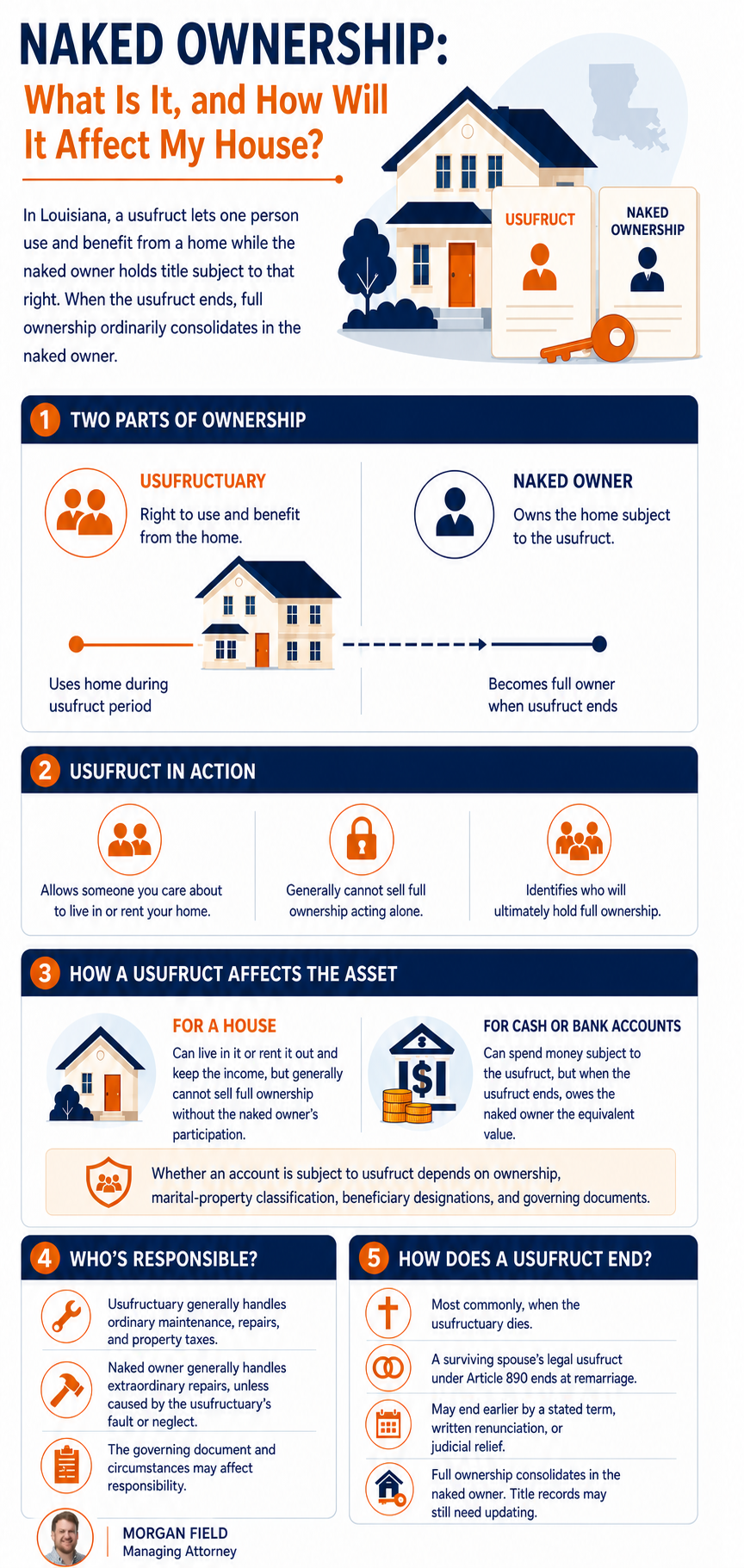
In Louisiana, usufruct and naked ownership can allow one person to use and benefit from a home while another person owns the property subject to that right. When the usufruct ends, the naked owner ordinarily becomes the full owner.
Usufruct, Usufructuaries, and Naked Owners
Louisiana law does not require a house to be left to one person in full ownership. Instead, an estate plan may allow one person to live in the house or collect rent from it while another person holds naked ownership.
A usufruct is a limited real right over property belonging to another person. The person holding that right is the usufructuary. The naked owner owns the property subject to the usufruct but generally cannot use and enjoy it until the usufruct ends. The exact rights involved depend on the property and the document or law that created the usufruct. Louisiana Civil Code article 535 provides the basic definition.
A usufruct does not always result from a will or another estate-planning document. It can also arise automatically under Louisiana law.
When a married person dies without disposing of the relevant property by testament and is survived by descendants, the descendants inherit the decedent’s share of the community property subject to a usufruct in favor of the surviving spouse. The descendants hold naked ownership, while the surviving spouse may use and benefit from the property. Under Louisiana Civil Code article 890, this legal usufruct ends when the surviving spouse dies or remarries.
Our discussion of what a surviving spouse receives in an intestate Louisiana succession explains how community property, separate property, and descendants affect the result.
Usufruct in Action
Suppose you want an elderly parent, sibling, or spouse to continue living in your home after your death, but you ultimately want the property to belong to one of your children.
A properly drafted estate plan may give the person living in the home a usufruct while giving the child naked ownership. The usufructuary can use the home for the duration of the usufruct. When the usufruct ends, the child’s naked ownership consolidates into full ownership.
This arrangement can provide housing or income for someone you care about while identifying who will ultimately own the property. However, the terms must be drafted carefully. The duration of the usufruct, the usufructuary’s powers, responsibility for expenses, and any power to sell or otherwise dispose of the property should be considered before the plan is signed.
Can a Usufructuary Sell the House?
A usufructuary generally cannot transfer full ownership of a house acting alone unless the document creating the usufruct grants a power of disposition or another provision of law permits it. The naked owner owns the underlying title and ordinarily must participate in a voluntary sale of the entire property.
If property subject to a usufruct is sold by agreement, the usufruct ordinarily attaches to the money or other property received unless the parties agree otherwise. Louisiana Civil Code article 616 governs this issue.
The sale documents and distribution of the proceeds should clearly reflect what the parties intend. Our article on Louisiana usufructs, sale proceeds, gifts, and depreciating assets examines these issues in more detail.
How Does a Usufruct Affect a Bank Account?
A usufruct works differently depending on whether it covers consumable or nonconsumable property.
A house is generally nonconsumable property. The usufructuary may use it and receive its fruits, such as rental income, but ordinarily must preserve the property’s substance.
Money is consumable property. A usufructuary may generally spend money subject to the usufruct, but when the usufruct ends, the usufructuary or the usufructuary’s estate may owe the naked owner the value that the property had when the usufruct began.
Whether a particular bank account or portion of an account is subject to a usufruct depends on ownership, marital-property classification, beneficiary designations, the succession judgment, and any applicable estate-planning documents.
Who Is Responsible for the House?
Louisiana law generally makes the usufructuary responsible for ordinary maintenance and repairs needed to keep the property in good order. The naked owner is generally responsible for extraordinary repairs unless they became necessary because of the usufructuary’s fault or neglect. Extraordinary repairs generally involve reconstruction of the whole or a substantial part of the property. See Louisiana Civil Code articles 577 and 578.
The usufructuary is also generally responsible for periodic charges imposed during the usufruct, including property taxes, under Louisiana Civil Code article 584.
The instrument creating the usufruct and the particular circumstances should always be reviewed before deciding who must pay a specific expense. Disagreements about maintenance, repairs, rent, insurance proceeds, or the use of the property can lead to succession litigation.
How Does a Usufruct End?
A usufruct most commonly ends when the usufructuary dies. It may also end when:
- A stated term expires or a specified condition occurs.
- A surviving spouse with a legal usufruct under Article 890 remarries.
- The usufructuary validly renounces the usufruct.
- The usufruct and naked ownership become vested in the same person.
- The property is lost, destroyed, or otherwise affected in a manner that terminates the usufruct.
- A court grants relief because the usufructuary has abused the property or failed to perform required obligations.
When the usufruct ends, the naked owner ordinarily becomes the full owner by operation of law. Because the naked owner already held title, the property generally does not have to be inherited again from the usufructuary. However, additional documents may need to be recorded in the parish conveyance records to establish that the usufruct has ended and clear the property’s title.
Field Law Can Help
Usufruct and naked ownership can be useful estate-planning tools, but unclear terms can create problems involving possession, repairs, expenses, sales, and ownership after the usufruct ends. Field Law can help you create an estate plan involving Louisiana property or address an existing dispute between a usufructuary and naked owner. Contact Field Law to schedule a consultation.