|
|
Last
Modified on
Aug 02, 2026
Many people assume they do not need a will because they are not wealthy. They may own a modest home, a vehicle, a checking account, and ordinary personal belongings—but nothing they consider a substantial “estate.”
A will is not only for people with significant wealth. It is for anyone who wants a voice in what happens to their property and family after death.
In Louisiana, even a relatively modest estate can present difficult questions:
- Who should care for minor children?
- Who should manage money inherited by those children?
- Should an estranged adult child inherit?
- What happens if someone claims to be a previously unrecognized child?
- Will a surviving spouse inherit separate property?
- Should children receive property outright or subject to a surviving spouse’s usufruct?
- Who should handle the succession?
Without a valid will, Louisiana’s default intestacy laws answer those questions. Those answers may be very different from what you intended.
You Probably Own More Than You Think
An estate does not have to include a large investment portfolio or expensive real estate.
Your estate may include:
- A house or an interest in a house
- A vehicle
- Bank accounts without a valid payable-on-death designation
- Furniture, jewelry, tools, firearms, and other personal property
- Mineral or royalty interests
- An ownership interest in a business
- Money owed to you
- Tax refunds
- Security deposits
- Digital assets
- Property inherited from parents or other relatives
- Life insurance or retirement benefits payable to your estate
- Property acquired after your will is signed
Some accounts pass through beneficiary designations rather than a will. That does not make a will unnecessary. Beneficiary designations can fail, beneficiaries can die first, and people often own property that has no automatic transfer mechanism.
Your estate may also grow over time. A will prepared when your property is modest can provide essential instructions if your circumstances change unexpectedly.
A Will Lets You Name a Tutor for Minor Children
For parents, the most important provision in a will may have nothing to do with money.
Louisiana generally uses the term tutor rather than guardian for the person appointed to care for a minor child. A properly prepared will allows a qualifying parent to nominate the person they want to serve in that role if neither parent remains able to care for the child.
Under Louisiana Civil Code Article 257, the right to appoint a tutor generally belongs to the parent dying last. The court must still confirm the appointment and consider the child’s best interests, but the parent’s written nomination gives the court important guidance.
Without that nomination, relatives may disagree over who should raise the child, and the court may have to decide without knowing whom the parent trusted.
Parents should also name one or more alternate tutors. The first choice may die, become incapacitated, move, or decide that they cannot accept the responsibility.
Our article, How Do I Name a Guardian for My Minor Child in Louisiana?, explains the tutorship process and the factors parents should consider.
A Will Can Create a Trust for a Minor Child
Naming the person who will raise your child is only part of the plan. You must also decide who will manage the child’s inheritance.
Leaving property directly to a minor can create the need for a court-supervised tutorship of the child’s property. The child may then receive control of the remaining property upon reaching adulthood, whether or not the child is financially prepared.
A will can create a testamentary trust for a child. The trust can identify:
- Who will serve as trustee
- How money may be used for the child
- Whether funds may pay for education, health care, housing, and support
- When the child may receive distributions
- The age at which the trust will end
- Who will serve if the first trustee cannot act
- What happens if the child dies before receiving the entire trust
The person raising the child and the person managing the inheritance can be the same individual, but they do not have to be. Some parents prefer to divide the responsibilities based on each person’s strengths.
A trust can be valuable even when the initial estate appears modest. Life insurance, the value of a home, retirement benefits, and property acquired later can leave a child with substantially more than the parent expected.
Our guide to wills and trusts in Louisiana explains some of the differences between these planning tools.
An Estranged Child May Still Inherit If You Die Without a Will
Family estrangement does not automatically eliminate inheritance rights.
If you die intestate, Louisiana law—not the history of your relationship—determines who inherits. An adult child whom you have not seen or spoken to in years may still inherit as a descendant.
In fact, a 2026 Louisiana legislative resolution specifically recognized that current law does not provide a way to prevent an estranged descendant from inheriting when the parent dies without a will. The Legislature directed the Louisiana State Law Institute to study the issue, but that study does not itself change current inheritance law.
A will can change that result, subject to Louisiana’s forced-heirship rules.
Adult Children Who Are Not Forced Heirs
An adult child who is over the forced-heirship age and is not permanently incapable of caring for their person or administering their estate generally does not have a legally reserved share.
A parent may ordinarily leave that child out of the will and leave the disposable estate to other people. Clear drafting can help show that the omission was intentional rather than an oversight.
Children Who Are Forced Heirs
Under Louisiana Civil Code Article 1493, forced heirs generally include:
- First-generation descendants who are 23 or younger when the parent dies
- First-generation descendants of any age who, because of qualifying mental incapacity or physical infirmity, are permanently incapable of caring for themselves or administering their estates
A forced heir cannot simply be omitted without addressing the child’s forced portion. Disinheriting a forced heir requires a legally recognized just cause and compliance with Louisiana’s testamentary requirements.
One statutory cause can involve an adult child who knew how to contact the parent but failed to communicate without just cause for two years. However, estrangement is not automatically sufficient in every case. Louisiana Civil Code Article 1621 lists the permitted causes, and Article 1624 requires the will to state the reason, facts, or circumstances supporting the disinherison.
Our article, Can You Disinherit Immediate Family Members Under Louisiana Law?, discusses those rules more fully.
A Will Can Reduce the Inheritance Consequences of a Filiation Claim
A will cannot prevent someone from filing a legal action claiming to be the decedent’s child. It can, however, prevent the estate from being intestate and may significantly change whether a successful filiation claim produces an inheritance.
When a person dies without a will, descendants are first in line to inherit. Louisiana Civil Code Article 888 provides that descendants succeed to the property of their ascendants.
Suppose a person dies intestate with two recognized children. After the death, another person claims that the decedent was also their father. If the claimant proves filiation and satisfies the applicable deadline, the claimant may seek a descendant’s share of the intestate estate.
Under Louisiana Civil Code Article 197, a person asserting paternity after the alleged father’s death must prove it by clear and convincing evidence. For succession purposes, the action is subject to a one-year peremptive period beginning on the alleged father’s death.
A valid will changes the analysis. If the estate is left to a spouse, named children, or other legatees, an adult claimant who is not a forced heir does not automatically receive an intestate share merely by proving filiation.
A claimant who qualifies as a forced heir may still assert rights to a forced portion. The person might also challenge the will or raise other claims. The will does not make litigation impossible, but it can prevent the default intestate distribution from giving every proven descendant an automatic share.
Our article on filiation fights in Louisiana successions explains how these claims arise after death.
A Surviving Spouse May Not Receive Your Separate Property Without a Will
One of the most dangerous Louisiana estate-planning assumptions is that a surviving spouse automatically inherits everything.
That is not how Louisiana intestacy law works.
Separate property may include:
- Property owned before the marriage
- Property inherited individually during the marriage
- Property donated to one spouse individually
- Property acquired with properly traceable separate funds
- Certain other property classified as separate under Louisiana law
If the deceased spouse leaves descendants, those descendants ordinarily inherit the deceased spouse’s separate property. The surviving spouse does not inherit that separate property merely because the couple was married.
If there are no descendants, parents, siblings, or descendants of siblings may have rights before the surviving spouse. Under Louisiana Civil Code Article 894, the surviving spouse inherits separate property intestate only when the decedent leaves no descendants, parents, siblings, or descendants of siblings.
That means a spouse could be living in a home that was the deceased spouse’s separate property but have no ownership interest in it after the death.
A will can leave separate property to the surviving spouse, subject to forced-heirship rules and any other applicable protections or restrictions. It can also grant the spouse a usufruct, place the property in trust, or create another arrangement designed around the family’s goals.
A Will Can Determine What Your Children Receive
Some parents want all of the property they own at death to go to their children. Intestacy may not produce that result in the way they expect.
Separate property generally passes to descendants when a parent dies intestate. Community property is different.
Each spouse already owns an undivided one-half interest in community property. When one spouse dies with descendants, the descendants generally inherit the deceased spouse’s one-half interest, subject to a legal usufruct in favor of the surviving spouse.
Under Louisiana Civil Code Article 890, the surviving spouse’s intestate usufruct over the decedent’s share of community property ordinarily ends at the surviving spouse’s death or remarriage.
The children therefore may receive only naked ownership of the deceased parent’s community share while the surviving spouse holds the usufruct. That arrangement may be appropriate for some families, but it can also create disputes over expenses, repairs, investments, sales, and the use of property.
A will permits the parent to decide whether the surviving spouse should receive:
- Full ownership
- A lifetime usufruct
- A usufruct that continues or ends under specified terms
- Benefits through a trust
- Particular property rather than a blanket interest
The will can also leave the deceased parent’s property directly to the children without the default spousal usufruct, subject to forced-heirship and other applicable laws.
Importantly, a person’s will can dispose only of property that person owns. One spouse cannot use a will to give away the surviving spouse’s one-half interest in community property.
A Will Lets You Choose Who Handles the Succession
A will can nominate the person who should serve as executor and administer the succession.
Without a will, the court may appoint an administrator under Louisiana’s statutory priorities. That person may not be the family member you would have selected.
An executor may be responsible for:
- Locating and protecting property
- Identifying heirs and legatees
- Preparing the estate inventory
- Addressing debts and expenses
- Maintaining financial records
- Communicating with family members
- Obtaining court authority when required
- Completing distributions
Selecting a trustworthy, organized person—and naming an alternate—can make the administration more orderly.
A Will Does Not Avoid Succession, but It Controls the Succession
A Louisiana will does not ordinarily avoid the court succession process. The will must generally be filed and recognized, and the court must place the legatees into possession.
The value of the will is control. It determines who receives succession property, nominates the executor, permits trusts and usufructs, and documents decisions that would otherwise be left to intestacy law.
If avoiding succession is also a priority, a properly funded revocable trust or other ownership arrangement may be appropriate. A will and trust can be used together as parts of a coordinated estate plan.
Louisiana Wills Must Meet Louisiana Requirements
An informal document may express your wishes without qualifying as a valid testament.
Louisiana recognizes specific forms of wills and imposes execution requirements. Under Louisiana Civil Code Article 1576, a notarial testament must be written, dated, executed before a notary and two witnesses, and properly signed.
Additional requirements may apply depending on the testator’s circumstances. Using an online form prepared for another state can create serious validity problems.
If a will is invalid, the estate may be treated as intestate—the exact result the person attempted to prevent.
Field Law Can Help You Create a Will That Fits Your Family
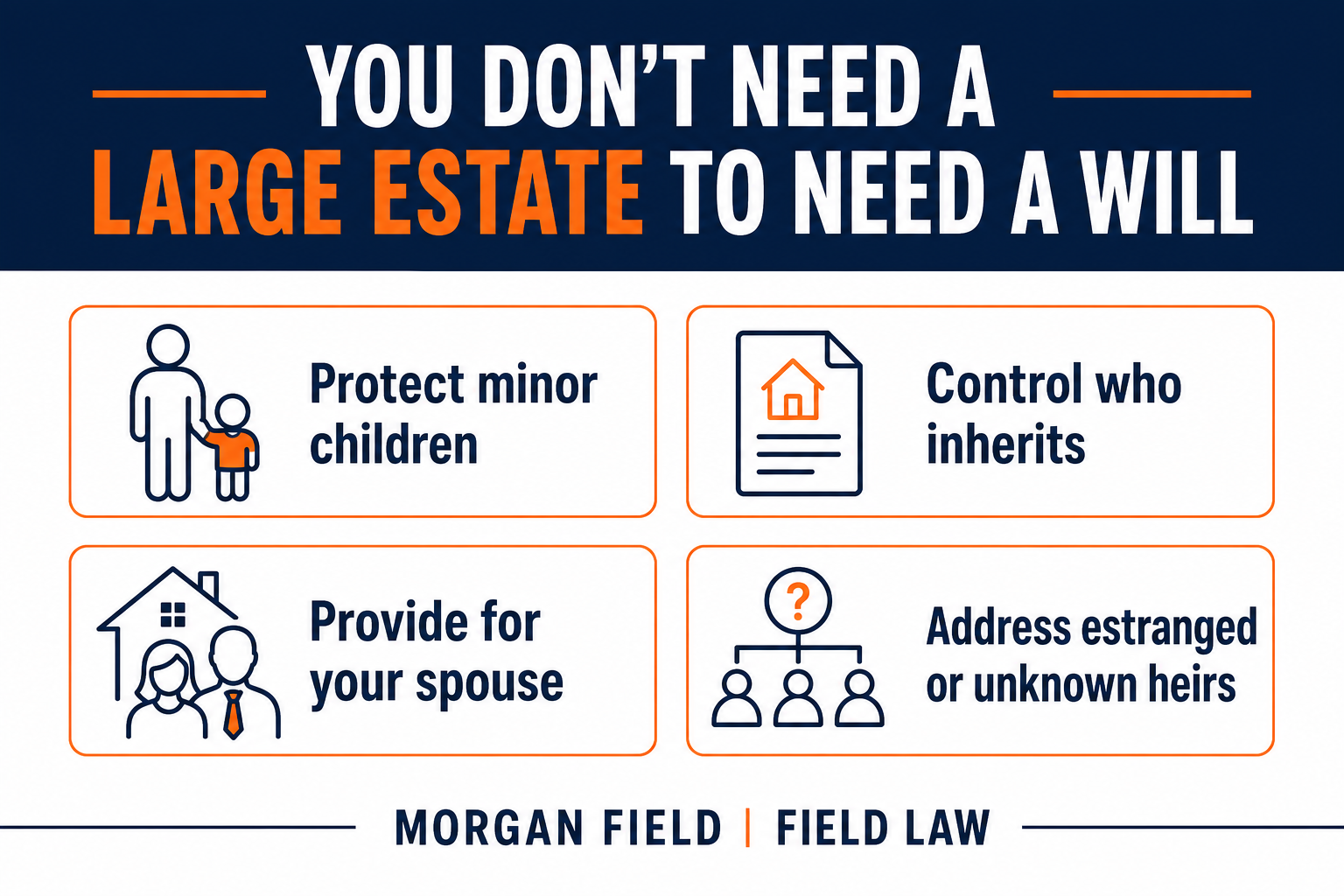
You do not need a large estate to need a will. You need a will when Louisiana’s default rules do not match what you want for your spouse, children, property, or succession.
Field Law helps Louisiana clients prepare wills that address minor children, testamentary trusts, separate and community property, estranged relatives, forced heirs, potential filiation issues, and the selection of an executor.
Even when the property is modest, clear instructions can prevent major uncertainty for the people left behind.
To discuss creating or updating your Louisiana will, contact Field Law to schedule a consultation.