|
|
Last
Modified on
Aug 02, 2026
A Louisiana pet emergency plan answers a practical question: Who will care for your animals if you are suddenly hospitalized, incapacitated, displaced by a hurricane, or unable to return home?
A pet trust can provide long-term funding and enforceable instructions after an owner’s death. However, a trust alone may not tell first responders who is waiting inside the house, give a caregiver immediate access, or explain which medication a pet needs tonight.
Effective planning requires both legal documents and an accessible set of instructions.
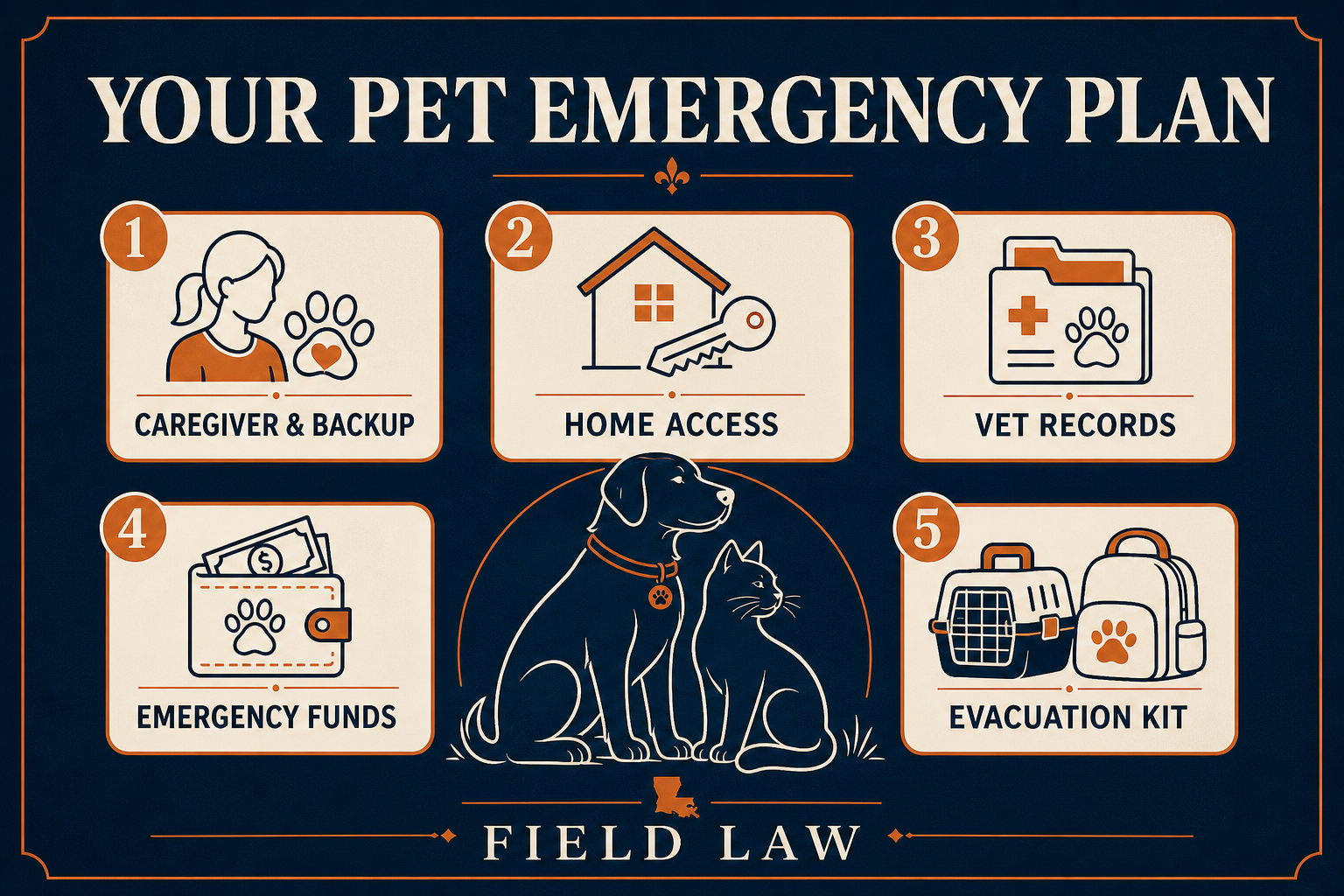
A Pet Emergency Plan and a Pet Trust Serve Different Purposes
These two parts of the estate plan should work together, but they solve different problems.
A pet emergency plan addresses immediate needs such as:
- Who can enter the home
- Who will provide temporary care
- Where food and medication are stored
- Which veterinarian should be contacted
- How emergency expenses will be paid
- Where the pet can stay
- What happens if the first caregiver is unavailable
A Louisiana pet trust provides longer-term legal and financial protection. It may identify a permanent caregiver, appoint a trustee, provide funding, and create enforceable standards for the animal’s care.
This article focuses on the immediate plan. Our guide to accounting for pets in estate planning explains the long-term pet-trust options.
1. Choose an Immediate Caregiver and a Backup
Start by choosing someone who can respond quickly if you do not return home.
The immediate caregiver may be a relative, friend, neighbor, employee, pet sitter, or other trusted person. Proximity matters. A person who lives ten minutes away may be more useful during the first night than a family member who lives in another state.
Before naming someone, ask:
- Is the person willing to help?
- Can the person enter your home?
- Does the person know the animals?
- Can the person safely handle them?
- Does the person’s housing permit animals?
- Are there other pets or children in the caregiver’s home?
- Can the caregiver transport the animal?
- Is the person comfortable giving medication?
- How long can the person provide care?
Always select at least one backup. The first caregiver may be traveling, dealing with an emergency, or unable to take the animal permanently.
Different Animals May Need Different Caregivers
One person may not be able to care for every animal.
A relative may happily accept a dog but be unable to manage a horse, bird, reptile, or animal with behavioral or medical needs. Multiple pets may need to stay together, while others may be safer in different homes.
The plan should identify the best arrangement for each animal rather than assuming that one caregiver fits every situation.
2. Prepare a Written Pet Profile
The caregiver should not have to reconstruct the animal’s routine during a crisis.
Create a separate profile for each pet. Keep a printed copy in an accessible location and an electronic copy that the caregiver can retrieve remotely.
The profile should include:
Identification
- Name and photograph
- Species and breed
- Age and sex
- Color and identifying marks
- Microchip number and registration company
- License or tag information
- Adoption or ownership records
Veterinary Information
- Veterinarian’s name and telephone number
- Emergency veterinary clinic
- Vaccination history
- Medical conditions
- Allergies
- Current medications
- Medication dosage and schedule
- Pet-insurance information
- Pharmacy information
- Copies of important medical records
Daily Care
- Food brand and quantity
- Feeding schedule
- Location of food and supplies
- Exercise routine
- Grooming needs
- Sleeping arrangements
- Litter, crate, or outdoor routine
- Commands the pet recognizes
- Favorite toys or comfort items
Behavioral Information
- Fears and triggers
- History of biting or aggression
- Reactions to children or other animals
- Escape behavior
- Handling restrictions
- Separation anxiety
- Safe methods of transport
Behavioral information protects both the animal and the caregiver. Do not minimize difficult behavior out of embarrassment. The caregiver needs accurate information to respond safely.
3. Make Sure Someone Can Reach the Pet
Naming a caregiver does little good if that person cannot enter the home.
Consider how the caregiver will obtain:
- A house key
- Gate or building access
- Alarm instructions
- Safe combinations
- Landlord or property-manager contact information
- The location of carriers, leashes, and supplies
- Instructions for finding an animal that hides
Avoid putting sensitive access information in a publicly visible document. Instead, tell the caregiver how to retrieve it securely.
Use an Emergency Contact Card
Carry a wallet card stating that animals may be alone at your home. The card can identify:
- The number and type of animals
- The immediate caregiver’s name
- The caregiver’s telephone number
- A backup contact
- Your veterinarian
You can also place a notice inside the home near the primary entrance. It should tell an authorized person whom to contact without unnecessarily advertising that the property is unattended.
Add the same information to your phone’s emergency contacts when appropriate.
4. Address Care During Incapacity
A will takes effect only after death. It does not authorize someone to care for your pet or use your money while you are living but incapacitated.
A Louisiana financial mandate—commonly called a power of attorney—can authorize a mandatary to manage the principal’s affairs during incapacity. The document can include pet-related authority, such as the ability to:
- Arrange temporary or permanent care
- Pay veterinary and boarding expenses
- Purchase food, medicine, and supplies
- Communicate with veterinarians
- Access pet records
- Transport or relocate the animal
- Enter contracts for care
- Use the principal’s funds for reasonable expenses
Louisiana mandates are generally durable. Louisiana Civil Code Article 3026 provides that, unless the document states otherwise, the principal’s incapacity does not terminate the mandate.
Our article on how a Louisiana contract of mandate protects your interests explains this document in greater detail.
Ask the Veterinarian About Its Forms
A veterinary clinic may have its own authorization or payment forms. Ask what the clinic would require before allowing another person to approve treatment or access records.
Provide the veterinarian with updated contact information for the person expected to act. However, do not rely only on a notation in the clinic’s file. The complete plan should also address financial authority and home access.
A Mandate Ends at Death
A financial mandate is useful during incapacity, but it is not a substitute for a will or trust.
Under Louisiana Civil Code Article 3024, the mandate and the mandatary’s authority generally terminate when the principal dies.
After death, the will, trust, and Louisiana succession process become important. The documents should therefore create a smooth transition from the temporary caregiver to the person who will have permanent custody.
5. Plan for Immediate Expenses
Food, medication, veterinary treatment, and boarding expenses begin immediately. The caregiver should know how those expenses will be handled.
Possible arrangements include:
- Authority under a financial mandate
- Reimbursement instructions
- A payment method maintained for pet expenses
- Pet insurance
- A written agreement with the caregiver
- A gift through the will
- A funded pet trust
The safest arrangement depends on whether the owner is temporarily unavailable, permanently incapacitated, or deceased.
Avoid giving someone unrestricted access to a bank account without considering the broader financial consequences. Instead, coordinate the payment plan with the mandate and other estate-planning documents.
A Gift to the Caregiver Is Not the Same as a Pet Trust
A will can leave the animal and money to a caregiver. However, an unrestricted gift generally becomes the caregiver’s property. The gift does not necessarily require the recipient to spend the entire amount on the animal.
A properly drafted pet trust separates the care obligation from the management of the money. Louisiana Revised Statute 9:2263 allows a trust to provide for one or more identifiable animals. The statute permits the trust to name a caregiver, a trustee, and a person with authority to enforce the trust.
That legal structure belongs in the long-term plan. The emergency plan should explain how expenses will be covered before the trust or succession administration becomes fully operational.
6. Prepare for Hurricanes and Evacuations
Louisiana pet planning should include hurricanes, floods, and other evacuations.
The Louisiana State Animal Response Team encourages animal owners to prepare for evacuation or emergency care before a disaster occurs.
A pet evacuation kit should include:
- Food and bottled water
- At least two weeks of medication when possible
- Food and water bowls
- Leashes, harnesses, and carriers
- Waste bags or litter supplies
- Bedding and comfort items
- Veterinary records
- Vaccination and rabies certificates
- Microchip information
- Current photographs
- Cleaning supplies
- Basic first-aid supplies
- Emergency contact information
The LSU AgCenter also recommends maintaining current identification, vaccination records, medications, carriers, and an emergency contact list. Its Louisiana pet-preparedness guidance emphasizes preparing before a storm is already approaching.
Identify Evacuation Destinations
Determine in advance:
- Which relatives or friends can accommodate the animals
- Which hotels accept pets
- Which boarding facilities can receive them
- Which shelters accommodate animals
- How large animals will be transported
- Who can evacuate the animals if you are unavailable
Do not assume that every emergency shelter, hotel, or family member can accept every type of animal.
7. Coordinate the Emergency Plan With the Will
A will can identify who should receive ownership of the pet after death. It should also name one or more alternate recipients.
Before naming a person or organization:
- Obtain the person’s agreement
- Confirm that the person can accept the animal
- Ask whether the person expects financial assistance
- Discuss whether multiple pets should remain together
- Confirm any rescue organization’s current intake policies
- Name a backup if the first choice cannot serve
A will can also direct the executor to deliver the animal, supplies, records, and any related gift to the selected caregiver.
However, the original will may not be immediately available during an emergency. The separate pet-care instructions should identify the temporary caregiver and where the estate-planning documents can be found.
Learn more about the role of a Louisiana will in our article on the importance of a last will and testament.
8. Decide Who Can Make Difficult Veterinary Decisions
The plan should identify who may approve emergency treatment if you cannot communicate.
Discuss your general preferences concerning:
- Emergency surgery
- Specialist treatment
- Significant veterinary expenses
- Chronic illness
- Pain management
- Quality-of-life decisions
- Euthanasia
- Disposition of remains
These decisions cannot always be made in advance with rigid instructions. The animal’s condition, prognosis, pain, and available treatment may change. The caregiver should understand your priorities and be willing to consult with the veterinarian.
If one person will provide daily care while another controls the funds, the documents should explain how they communicate and who has final authority.
9. Create a One-Page Emergency Summary
The complete pet profile may contain several pages. Create a one-page summary for immediate use.
Include:
- Each animal’s name and photograph
- Immediate caregiver and telephone number
- Backup caregiver
- Veterinarian and emergency clinic
- Essential medications
- Feeding instructions
- Location of carriers and supplies
- Home-access instructions or how to obtain them
- Important behavioral warnings
- Location of the full pet-care plan
- Location of the estate-planning documents
Give copies to the primary caregiver, backup caregiver, mandatary, and another trusted person.
10. Review the Plan Regularly
Pet-care arrangements can become outdated quickly.
Review the plan at least annually and whenever:
- You adopt another animal
- A pet dies
- The caregiver moves
- The pet develops a medical condition
- Medication changes
- You change veterinarians
- The caregiver can no longer serve
- You move
- Access codes or keys change
- The pet’s expected care costs change
- You update your will, trust, or mandate
Confirm that the caregiver remains willing to serve. An old plan naming someone who cannot be reached is not an effective plan.
Field Law Can Help
A Louisiana pet emergency plan should work before a trust or succession is needed. It should identify who can reach the animal, provide immediate care, obtain veterinary treatment, and pay necessary expenses during an emergency.
The will, mandate, and pet trust should then provide legal authority and long-term continuity.
At Field Law, estate planning and successions are the focus of our practice. We help Louisiana pet owners coordinate immediate care instructions with wills, mandates, and pet trusts designed around their animals’ actual needs.
Contact Field Law to schedule a consultation and create a complete Louisiana estate plan for you and the animals who depend on you.