


The short answer is that you may be able to do a succession yourself in Louisiana. However, the better question is whether the particular estate is simple enough to make self-filing practical.
Some families can transfer property through a small-succession affidavit without opening a court proceeding. Others need a judge to probate a will, recognize the heirs, appoint a succession representative, or sign a judgment of possession.
Even an uncontested succession can produce costly problems if the pleadings identify the wrong heirs, misclassify property, omit an asset, or transfer real estate incorrectly.
| Situation | What to consider |
|---|---|
| Estate qualifies for an affidavit | No judicial opening may be necessary. Self-handling is most practical when heirship, ownership, values, and required signatures are clear. Verify eligibility first; a low value alone is insufficient. |
| Court is needed; family agrees | Agreement does not replace proof, correct pleadings, or a usable judgment. Review whether possession without administration is available and who will handle recordings and transfers. Legal help can have a defined scope and fee. |
| Authority or disputed rights need resolution | Administration, unclear ownership, missing heirs, a contested Will, or significant debt can make self-handling risky. Get advice before distributing assets or signing documents that assume the answer. |
Table of Contents
ToggleIs a court proceeding necessary?
Start by determining whether the estate qualifies for a small-succession affidavit.
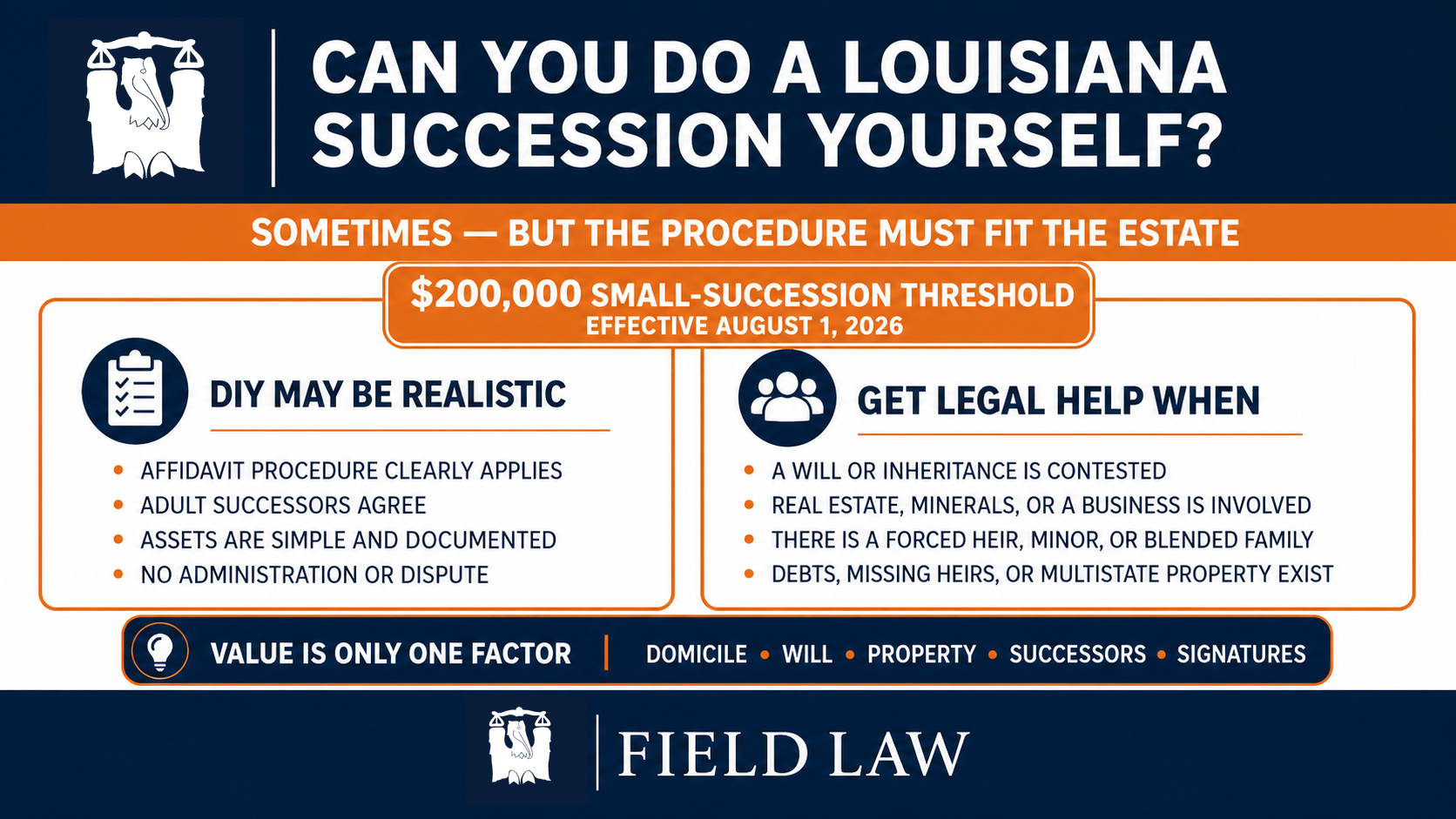
Effective August 1, 2026, Louisiana increased the small-succession threshold for a person domiciled in Louisiana to $200,000. The ordinary threshold for a nonresident’s Louisiana property remains $125,000; a separate 20-year rule can remove the value limit. However, value is not the only requirement. Eligibility also depends on matters such as:
- Where the decedent was domiciled;
- Whether the decedent left a will;
- Whether the estate includes immovable property;
- What the will provides;
- Who the heirs or legatees are; and
- Whether the required people can sign the affidavit.
When the statutory requirements are satisfied, an affidavit may allow the successors to collect money or transfer property without obtaining a judgment of possession. Our article When Can a Louisiana Family Use a Small-Succession Affidavit? explains that procedure in more detail.
If the estate does not qualify, a judicial succession will generally be necessary.
What does a judicial succession require?
A straightforward judicial succession may still require several documents, including:
- A petition to probate the will or open the succession;
- Affidavits establishing death, domicile, family relationships, and other facts;
- The original will, when one exists;
- A detailed descriptive list of assets and debts;
- Renunciations, waivers, or verifications;
- Pleadings placing the heirs or legatees into possession;
- A proposed judgment of possession; and
- Certified copies for banks, conveyance records, or other institutions.
The documents must match one another. Names, dates, legal descriptions, ownership percentages, marital information, and property classifications must remain consistent throughout the filings.
The clerk of court can accept documents and collect filing fees, but court personnel generally cannot decide who inherits, draft pleadings, or advise a family how Louisiana law applies to its facts.
When might a self-filed succession be manageable?
A family may reasonably consider handling the matter without full legal representation when:
- The estate clearly qualifies for an affidavit procedure;
- All successors are adults with capacity;
- Everyone agrees about the relevant facts;
- The family relationships are uncomplicated;
- No one disputes the will;
- The property is easy to identify and value;
- There are no significant creditor or tax issues; and
- No succession administration is required.
Even then, the family should confirm that it has identified every heir and correctly classified the property.
For example, property purchased during a marriage may be community property even if only one spouse’s name appears on the title. Separate property may pass differently from community property. A surviving spouse may receive a usufruct while children receive naked ownership. Those distinctions affect the language required in the affidavit or judgment.
When is doing a succession yourself risky?
Legal assistance becomes more valuable when the succession involves:
- A will;
- A house, land, or mineral interests;
- Community-property questions;
- Children from different relationships;
- A surviving spouse and separate children;
- A forced heir;
- A minor or interdicted successor;
- An alleged child whose filiation is disputed;
- Missing or uncooperative heirs;
- A business or LLC interest;
- Substantial debts;
- Property located in another state;
- Competing wills;
- Suspected donations or withdrawals before death; or
- Any disagreement about ownership or inheritance.
These issues can change who inherits and what each person receives. They can also determine whether administration is required before the estate can be distributed.
If the succession requires an executor or administrator, that person assumes fiduciary responsibilities. Under Louisiana Code of Civil Procedure Article 3191, the succession representative must collect, preserve, and manage estate property as a prudent administrator and may be personally responsible for losses caused by failing to perform those duties properly.
What can go wrong with a do-it-yourself succession?
Common problems include:
- Leaving property out of the detailed descriptive list;
- Using an incomplete legal description for real estate;
- Naming the wrong heirs;
- Treating community property as separate property;
- Ignoring a usufruct;
- Failing to address a deceased heir’s descendants;
- Using an affidavit when a judicial proceeding is required;
- Paying or distributing estate property without proper authority;
- Failing to probate the correct will;
- Omitting necessary signatures; or
- Obtaining a judgment that a bank or title attorney cannot use.
Some errors can be corrected by filing supplemental pleadings. Others may require reopening the succession, amending the judgment, obtaining additional signatures, or litigating a dispute that could have been avoided.
A mistake may not become apparent until years later, when the family attempts to sell the property. At that point, an heir may have died, moved away, become incapacitated, or stopped cooperating.
Does an uncontested succession still need a lawyer?
An uncontested case is usually less expensive and more efficient than succession litigation, but agreement among the heirs does not eliminate Louisiana’s legal requirements.
The attorney’s role in an uncontested succession is often to:
- Determine who inherits;
- Review the will;
- Classify the property;
- Identify the correct procedure;
- Prepare consistent pleadings;
- Obtain the necessary signatures;
- Respond to the court;
- Secure the judgment of possession; and
- Provide certified documents that can be used to transfer the property.
We discuss that distinction in Do You Need a Lawyer for an “Uncontested” Louisiana Succession? If the family agrees and needs help with a Baton Rouge-area estate, our Baton Rouge uncontested succession service explains the proposed work, responsibilities, and fee discussion.
Legal help does not have to mean open-ended billing
Families sometimes consider filing without an attorney because they are worried about cost. However, many uncontested successions can be handled through a defined process and a fixed fee.
The appropriate fee depends on the will, family structure, property, debts, and whether administration is necessary. Asking for a scope of work and fee arrangement before starting allows the family to compare the cost of representation with the risk of correcting a defective filing later.
Field Law offers fixed-fee estate planning and succession services for qualifying matters.
How Field Law can help with a Louisiana succession
Whether you should do a succession yourself in Louisiana depends on more than the estate’s dollar value. The correct procedure turns on the will, family relationships, property classification, debts, and the type of assets involved.
Field Law helps Louisiana families determine whether an affidavit will work, whether a judicial succession is required, and what documents are needed to transfer the property correctly. We also work with out-of-state families remotely when Louisiana property is involved.
If you are deciding whether to handle a succession yourself or hire counsel, our Baton Rouge succession page explains how we help surviving spouses and adult children identify the next step. For families elsewhere, see our Louisiana succession service. You can contact Field Law to discuss the estate and available options.