|
|
Last
Modified on
Aug 02, 2026
If you live outside Louisiana but have been named as an executor—or expect to inherit as an heir or legatee—you may be wondering whether you will need to travel to Louisiana to complete the succession.
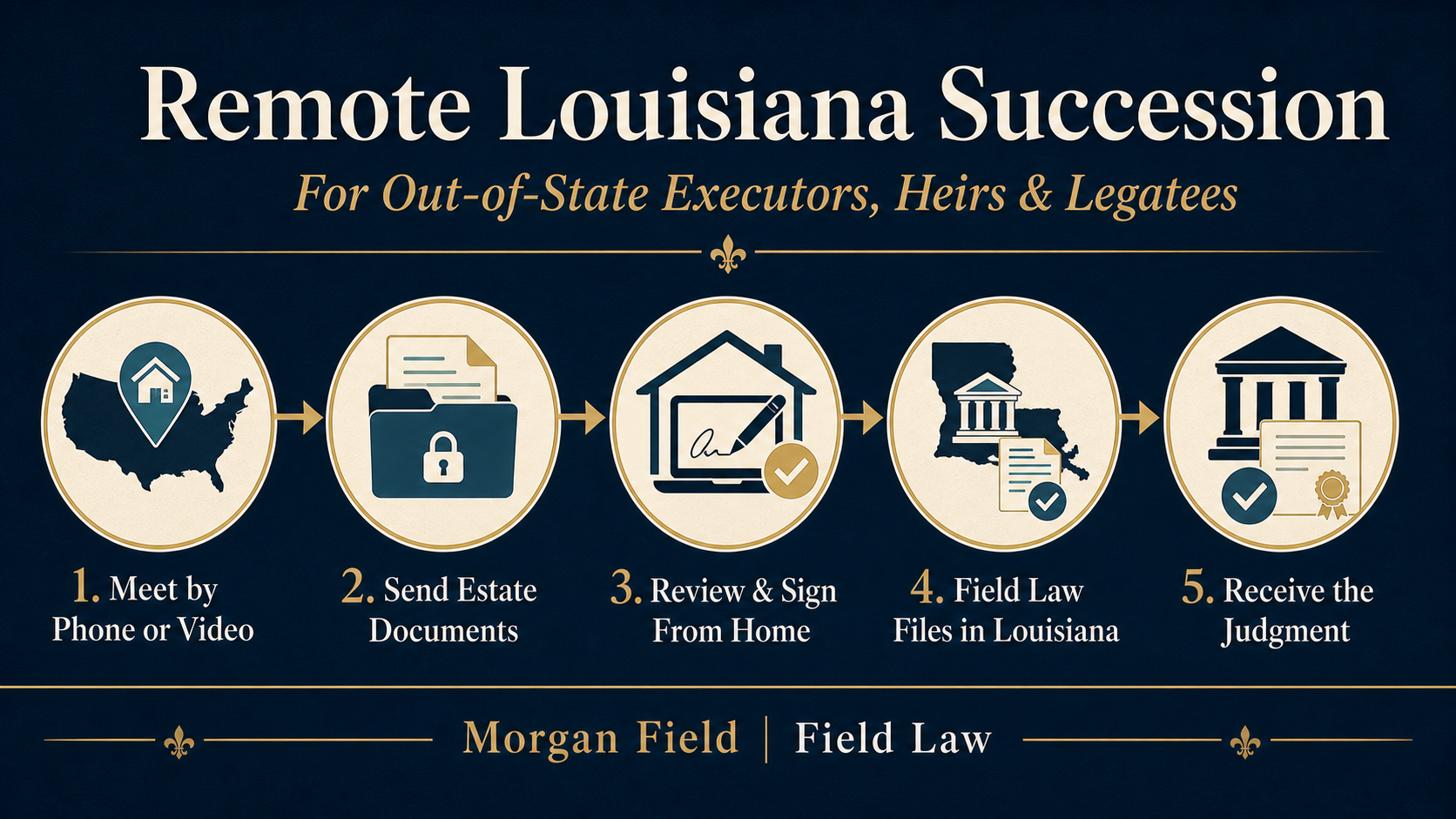
For a routine, uncontested Louisiana succession, the answer is generally no. Field Law can usually handle the legal process through telephone or video consultations, electronic document exchange, local court filings, and clear instructions for signing documents where you live.
You may need to mail an original will or signed documents to Louisiana, but that ordinarily does not require you to appear here personally.
What Is a Remote Louisiana Succession?
A remote Louisiana succession is not a separate type of court proceeding. It is a practical way of handling an ordinary Louisiana succession when the executor, heirs, or legatees live in another state.
Field Law handles the Louisiana side of the proceeding while communicating with the family by phone, video conference, email, and electronic document exchange. We prepare the pleadings, file them in the proper Louisiana court, communicate with the clerk and other local parties, and provide the documents needed to transfer property after the judgment is signed.
The fact that an heir or executor lives outside Louisiana does not change where the succession is filed. Under Louisiana Code of Civil Procedure Article 2811, the succession of a person domiciled in Louisiana at death is generally opened in the district court for the parish where that person was domiciled.
Is This an Ancillary Succession?
Not necessarily.
An ancillary succession generally involves a decedent who was domiciled outside Louisiana but left property located in Louisiana. That is different from a case in which the decedent lived in Louisiana but the executor, heirs, or legatees now live elsewhere.
This article focuses on the second situation: the Louisiana succession is the primary proceeding, but one or more of the people involved live out of state.
For a broader discussion of Louisiana inheritance rules, property issues, and practical concerns affecting nonresident families, see what out-of-state families need to know about Louisiana successions.
Who Is Involved in a Louisiana Succession?
Louisiana terminology can be unfamiliar to people accustomed to another state’s probate system.
An heir is generally someone who inherits under Louisiana law when the decedent did not leave a valid will.
A legatee is someone who receives property under a will.
An executor is the person nominated in a will and confirmed by the court to administer the succession. If there is no executor able to serve, the court may appoint an administrator or another type of succession representative.
Not every succession requires an executor or formal administration. In an uncomplicated estate that is relatively free of debt, the heirs or legatees may be able to petition for possession without a full administration. Whether that option is available depends on the will, debts, property, beneficiaries, and other circumstances.
Can an Out-of-State Executor Serve in Louisiana?
Yes. Louisiana law does not automatically disqualify someone from serving as executor merely because that person lives in another state.
Under Louisiana Code of Civil Procedure Article 3097, a nonresident succession representative must appoint a Louisiana resident agent for service of process and file that appointment in the succession proceeding.
An out-of-state executor should still consider whether they can practically perform the required duties. A succession representative is responsible for collecting, preserving, and managing succession property, addressing debts, maintaining records, and completing the administration in accordance with Louisiana law.
Field Law can explain the representative’s responsibilities, prepare the required court filings, and handle local legal work while the representative remains outside Louisiana.
What Can Field Law Handle Remotely?
The precise process depends on the estate, but Field Law can generally handle the following without requiring the client to travel:
- Conduct the initial consultation by telephone or video
- Determine which Louisiana court has jurisdiction
- Review the will and other estate-planning documents
- Identify the heirs, legatees, surviving spouse, and other interested parties
- Gather information about assets and debts
- Obtain or review deeds and other Louisiana public records
- Prepare petitions, affidavits, descriptive lists, and proposed judgments
- Send documents electronically for review
- Provide instructions for signatures and notarization
- File the succession pleadings in Louisiana
- Communicate with the clerk of court and judge’s office
- Respond to routine court questions or filing requirements
- Obtain certified copies of the judgment
- Provide the documents needed to address Louisiana real estate and other assets
The client ordinarily supplies information and documents from home while Field Law manages the Louisiana court process.
How Are Documents Signed From Another State?
Many succession documents can be signed before a notary where the executor, heir, or legatee lives and then returned to Field Law. Depending on the document and the court’s requirements, the signed original may need to be mailed to Louisiana.
Louisiana also recognizes remote online notarization for qualifying documents. However, Louisiana Revised Statute 35:623 places limits on remote notarization and excludes certain instruments, including testaments, trusts, donations, and authentic acts.
For that reason, remote does not always mean that every document can be signed electronically. Field Law will identify the proper signing method and give each person specific instructions. Even when a physical signature or original document is required, it can generally be completed where the client lives and sent to Louisiana without personal travel.
What Documents Should an Out-of-State Client Gather?
The documents needed will vary, but it is helpful to begin with:
- A certified death certificate
- The original will and any codicils
- Trust documents, if applicable
- The decedent’s full legal name and last Louisiana address
- Marriage, divorce, adoption, or death records affecting the family
- Names and contact information for heirs and legatees
- Bank and investment statements
- Retirement-account and life-insurance information
- Louisiana deeds and property-tax records
- Vehicle, boat, or business-ownership documents
- Mortgage, loan, credit-card, and medical-debt information
- Recent tax returns
- Information about pending lawsuits or disputed property
Do not delay the consultation simply because every document has not yet been located. An initial call can help determine what is actually needed and where missing information may be obtained. Our article explaining what a Baton Rouge succession consultation covers provides additional guidance.
Will the Heirs Have to Appear in Court?
In a routine uncontested succession, heirs and legatees often do not have to appear in court. The court may be able to decide the request by reviewing the petition, supporting affidavits, will, descriptive list, and other filed documents.
When the legal requirements are satisfied, the judge signs a judgment of possession recognizing the heirs or legatees and placing them into possession of the decedent’s property. Louisiana Code of Civil Procedure Article 3061 describes the effect and contents of that judgment.
A personal appearance becomes more likely if:
- Someone contests the will
- The heirs or legatees disagree
- The identity of an heir is disputed
- A succession representative is accused of misconduct
- Ownership or classification of property is contested
- Testimony or an evidentiary hearing is required
- The court specifically orders a person to appear
Even in a disputed matter, some conferences, depositions, or hearings may be conducted remotely. That decision ultimately belongs to the court and depends on the nature of the proceeding.
What Happens After the Judgment Is Signed?
The judgment of possession is the court order recognizing who inherits the succession property. Field Law can obtain certified copies and send them to the appropriate people or institutions.
Depending on the assets, additional work may include:
- Recording the judgment in the parish conveyance records
- Presenting certified copies to banks or financial institutions
- Transferring vehicles or other titled property
- Addressing mineral interests
- Updating insurance and property-tax records
- Completing a sale of Louisiana real estate
- Closing succession accounts
- Distributing remaining funds
Some banks, title companies, and government agencies require certified or original documents. Those requirements may involve mailing documents, but they ordinarily do not require the out-of-state heir or executor to travel to Louisiana.
Can an Uncontested Succession Be Completed Entirely Remotely?
In many cases, yes. A cooperative family, a valid will or clearly identifiable heirs, manageable debts, and complete asset information make remote handling easier.
An uncontested Louisiana succession may be completed through document exchange, signatures obtained where the parties live, and filings handled by Louisiana counsel.
No attorney should promise that travel will be impossible under every circumstance. A dispute, unusual asset, missing original will, title problem, or specific court order may change what is required. For a straightforward succession, however, personal travel is usually unnecessary.
Field Law Handles Louisiana Successions for Out-of-State Families
Distance should not prevent an executor, heir, or legatee from resolving a Louisiana succession.
Field Law regularly works with clients throughout the United States. We communicate by telephone, video, and electronic document exchange; prepare and file the Louisiana court documents; coordinate signatures; address local procedural requirements; and keep clients informed without requiring routine trips to Louisiana.
If you live outside the state and need help completing a Louisiana succession, contact Field Law to schedule a remote consultation.