|
|
Last
Modified on
Sep 14, 2026
When a loved one passes away and the family is in total agreement, it feels like the hardest part is behind you. No disputes, no drama, no lawsuits.
Naturally, the next thought is usually, “Great… so can we just take care of this ourselves?”
It’s a fair question. But in Louisiana, family agreement gets you halfway there; the law requires you to finish the rest. A house or bank account in your parent’s name doesn’t automatically transfer just because everyone agrees on who should get it.
At Field Law in Baton Rouge, our goal is to keep smooth situations smooth. Understanding Louisiana’s specific filing steps, timeline, and associated costs is one of the best places to start.
What Uncontested Really Means in a Louisiana Succession
An uncontested succession means every heir agrees on who inherits what, and nobody has filed an objection with the court. It says nothing about whether the estate needs a formal proceeding, and that’s where families get tripped up.
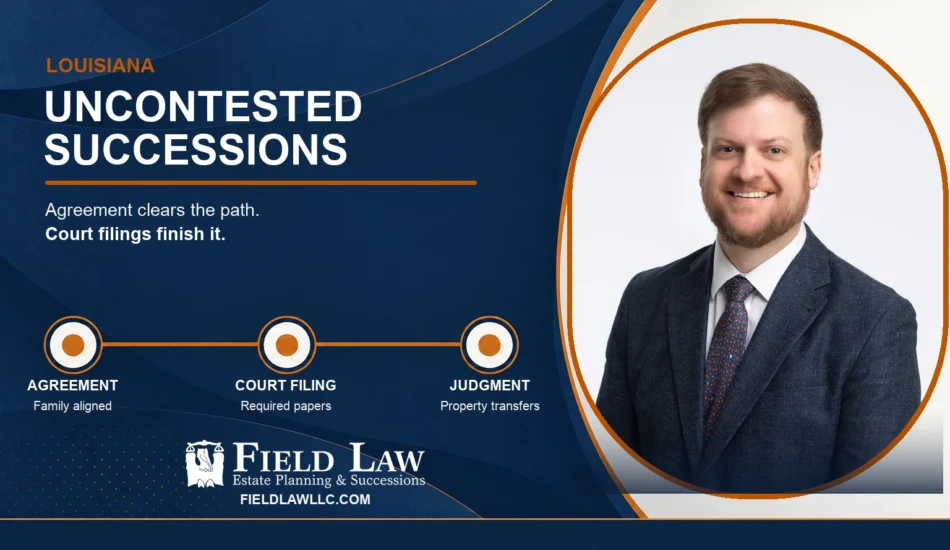
Uncontested is not another word for simple. A family that agrees on everything can still wait months for a judgment of possession if the estate includes a house, land in a different parish, or an account the bank won’t release without a court order. Agreement clears the path. It doesn’t skip the road.
Louisiana courts still require a petition, a sworn descriptive list of assets, and in most cases a judgment of possession before immovable property changes hands, agreement or not.
Which Path Fits Your Estate
Louisiana gives uncontested heirs different paths depending on the estate’s size, whether there’s a will, and what kind of property is involved.
No will (intestate)
When there’s no will, Louisiana’s intestacy rules decide who inherits based on marriage and blood relation. If every heir accepts and the estate is relatively free of debt, the court can send them into possession under Louisiana Code of Civil Procedure Article 3001 without opening a full administration. Minor or permanently disabled children may still hold forced heirship rights under Louisiana Civil Code Article 1493, regardless of what a will says.
With a will (testate)
The court probates the will first, then sends legatees (the legal term for those named in the will to receive property or money) into possession the same way, without an administrator, as long as nobody disputes the will itself.
Community property
A surviving spouse typically already owns half of what the couple acquired during the marriage. That half never enters the succession, which changes how much property needs court involvement in the first place.
The Small Succession Affidavit: When You Can Skip Court
Effective August 1, 2026, Act 293 raised Louisiana’s small-succession threshold to $200,000 for a person who died domiciled in Louisiana. Under Louisiana Code of Civil Procedure Article 3421, a Louisiana estate with a gross value of $200,000 or less may qualify as a small succession. A succession also falls within the statutory definition, regardless of value, when the death occurred at least 20 years before the affidavit. The $200,000 threshold does not, by itself, mean that every small succession can avoid court.
Whether the affidavit procedure is available depends on domicile, the existence of a will, and the type of property:
- If a person domiciled in Louisiana died without a will, the small-succession affidavit may include movable and immovable property.
- If a person domiciled in Louisiana died with a will, the affidavit procedure is available only when the person left no immovable property in Louisiana and the surviving spouse, heirs, and legatees required by law agree to waive probate of the will.
- Separate rules apply when the deceased lived outside Louisiana or died at least 20 years ago.
The signing requirements also change with the circumstances. For an intestate estate, at least two people generally sign, including the surviving spouse, if any, and one or more heirs. For a qualifying testate estate, all heirs and legatees, including the surviving spouse, if any, must sign. Code of Civil Procedure Article 3431 identifies which small successions may proceed without a judicial opening, while Articles 3432 and 3432.1 provide the affidavit requirements.
An uncontested succession attorney can determine whether the affidavit applies or whether the family needs a judicial succession. Reach out to Field Law today if you would like help choosing the proper procedure.
Filing a Full Succession: What the Timeline Looks Like
A full, uncontested succession with complete paperwork typically clears in 4 to 8 weeks from filing to judgment of possession, in the parish where your loved one lived.
The petition, the sworn descriptive list, and the judgment of possession move through the district court. In East Baton Rouge Parish, that’s the 19th Judicial District Court, where a staff attorney reviews every uncontested succession before it reaches a judge. Add a second parish with property, a missing heir, or an estate tax filing, and the same case stretches to six months or longer, with nobody disagreeing about anything.
Can You Handle This Without a Lawyer?
For the small succession affidavit, Louisiana doesn’t require an attorney, though most families use one anyway so a bank or title company doesn’t reject the paperwork. It’s always better to be safe than sorry.
Why Full Successions Usually Require Counsel
An individual heir may represent only that heir’s own interests. A family member cannot act as the lawyer for the estate or for the other heirs simply because everyone agrees. In a judicial succession, an attorney can prepare the required pleadings, address title and procedural issues, and present the proposed judgment of possession to the court.
What uncontested can turn into
Agreement can shift the moment an heir goes missing, a title company flags an old mortgage, or a cousin surfaces with a claim. The case still started uncontested, but it now needs a succession litigation attorney rather than a straightforward filing.
Frequently Asked Questions
What is the difference between an heir and a legatee?
The main difference is whether there is a will. An heir is a family member legally entitled to inherit property by law when someone dies without a will. A legatee is anyone—whether a family member, friend, or charity—named in a will to receive property or money.
In short: You are an heir by legal relation, but a legatee by choice in a will.
Does an uncontested succession still need to go through court in Louisiana?
Most do. For a person who died domiciled in Louisiana, an estate with a gross value of $200,000 or less may qualify as a small succession under Louisiana Code of Civil Procedure Article 3421. However, affidavit eligibility depends on the will, domicile, and property involved. An intestate small succession may include immovable property, while a Louisiana testate succession generally cannot use the affidavit procedure if it includes immovable property. If the affidavit procedure is unavailable, the family will need a judicial succession and a judgment of possession.
How long does an uncontested succession take in Louisiana?
A simple, complete filing usually takes 4 to 8 weeks from petition to judgment of possession, though exact timeframes can vary case to case. Add real estate in a second parish or a federal estate tax filing, and it can stretch past six months, even without any disagreement.
Can out-of-state heirs handle a Louisiana succession remotely?
Yes. Field Law regularly represents heirs living in Texas, Kentucky, and other states, using electronic filing and virtual signing so nobody has to travel to Baton Rouge. You’ll still need a Louisiana-licensed attorney to file, since the parish court won’t accept a petition from an out-of-state lawyer.
What turns an uncontested succession into a contested one?
A missing heir, a disputed will, or a creditor demanding administration can all shift the case. Once that happens, you’ll want a succession litigation attorney involved instead of relying on the simplified process alone.
Field Law: Your Louisiana Successions Law Firm
Agreement among your family is, ideally, the easier part. Getting a Louisiana court to recognize that agreement, clear title, and close the file is the part that eats weeks when nobody’s watched for it before.
Field Law focuses heavily on Louisiana estate planning and successions, serving clients in Baton Rouge and throughout the country. We are familiar with common filing issues that staff attorneys look for, and we work to structure your paperwork with the goal of avoiding unnecessary delays. If you are navigating an uncontested estate, contact our firm today to discuss how we can help you move the process forward cleanly and efficiently.