|
|
Last
Modified on
Aug 02, 2026
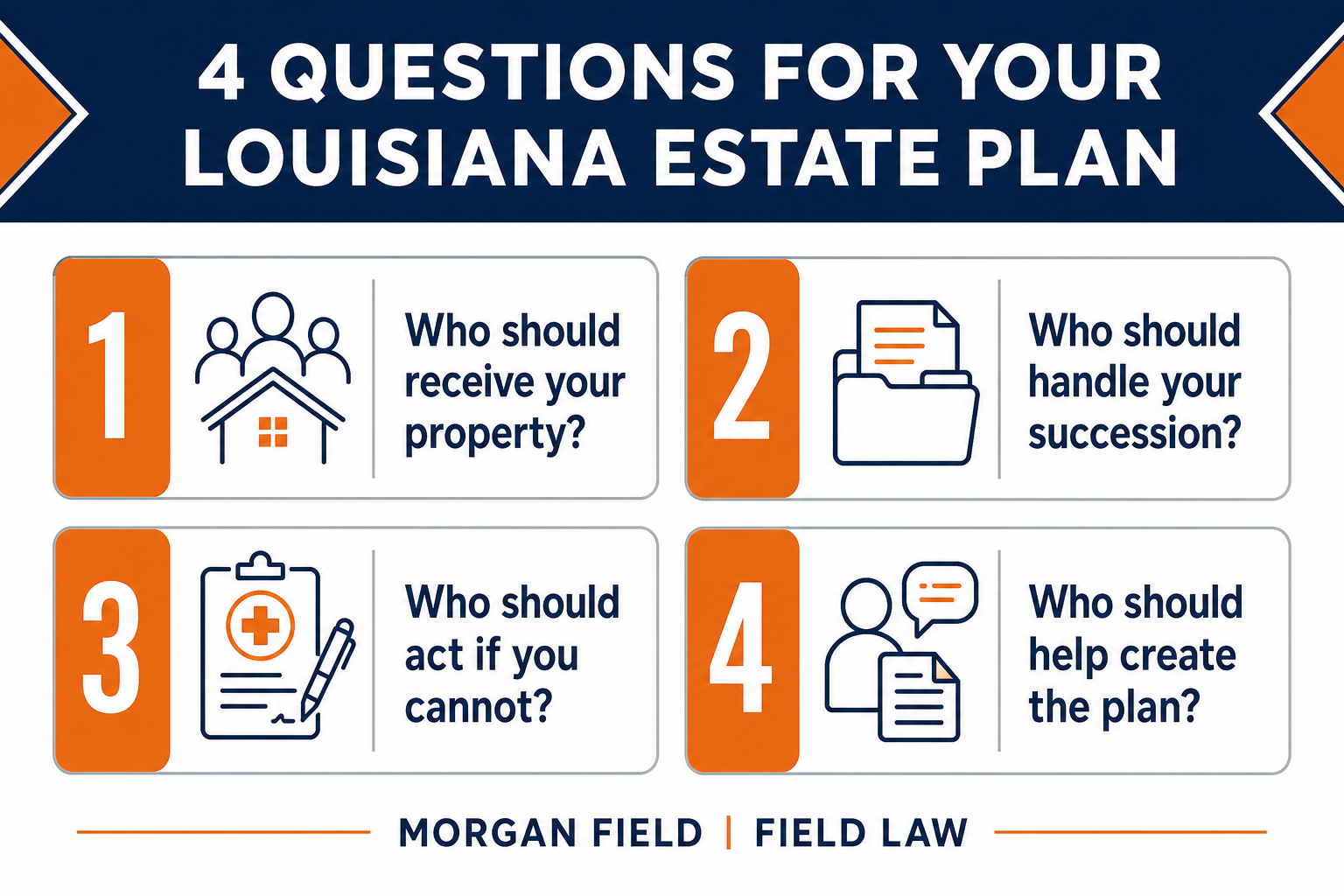
An estate plan is more than a list of property and instructions about what should happen after your death. A complete plan should address who receives your property, who will carry out your wishes, and who can act for you if illness or incapacity prevents you from making decisions yourself.
Your first estate plan does not have to be your last. In fact, it should be reviewed as your family, finances, and goals change. However, these four questions provide a useful starting point for creating a practical Louisiana estate plan.
1. Who Do You Want to Receive Your Property?
The first question is usually who should receive your property after your death.
Louisiana law distinguishes between heirs and legatees. Heirs inherit under Louisiana’s intestacy laws when a person dies without a valid will. Legatees are people or organizations that receive property through a will.
You may want to provide for:
- A spouse
- Children or grandchildren
- Other relatives
- An unmarried partner
- Friends
- A charitable organization
- A person with a disability
- Minor children
- A trust created for a particular beneficiary or purpose
- A pet through an appropriate planning arrangement
It is also important to decide what should happen if your first beneficiary dies before you. Naming alternate beneficiaries can prevent uncertainty and reduce the likelihood that Louisiana’s default inheritance rules will control that property.
Your ability to distribute property is not always unlimited. Louisiana’s forced-heirship law may reserve part of an estate for certain children. Under Louisiana Civil Code Article 1493, forced heirs generally include first-generation descendants who are 23 or younger at the decedent’s death and certain descendants who are permanently incapable of caring for themselves or administering their estates.
Our Louisiana forced-heirship guide explains those rules in greater detail.
Parents of young children should also consider more than who inherits. Leaving property directly to a minor can require court-supervised management. A trust may provide more control over how the inheritance is managed and when the child receives it. Parents can find additional considerations in our estate-planning checklist for Louisiana parents of minor children.
Finally, review beneficiary designations on life insurance, retirement accounts, and other accounts. Those designations should be coordinated with the will and trust rather than treated as an unrelated part of the plan.
2. Who Should Handle Your Succession?
A Louisiana will can nominate an executor to administer the estate. Once appointed by the court, that person serves as the succession representative and is responsible for carrying out the duties required by the will and Louisiana law.
An executor may need to:
- Locate the will and other important records
- Identify and protect estate property
- Prepare an inventory or detailed descriptive list
- Address valid debts and expenses
- Communicate with heirs and legatees
- Handle tax and accounting matters
- Obtain court approval when required
- Distribute property according to the judgment of possession
- Maintain accurate financial records
Choose someone who is trustworthy, organized, responsive, and able to work with attorneys, accountants, financial institutions, and family members. The person does not need to understand every aspect of succession law before accepting the role, but they should be willing to obtain professional guidance and follow the required process.
Family relationships also matter. Someone may be financially capable but poorly suited to serve if their appointment would create immediate distrust or conflict among beneficiaries.
Name at least one alternate executor in case your first choice dies, becomes incapacitated, declines to serve, or is otherwise unable to act.
An executor does not have unlimited authority over estate property. Our article, What Can’t a Succession Representative Do?, explains some of the legal limits placed on the person administering a Louisiana succession.
3. Who Should Act for You If You Become Incapacitated?
A will generally operates after death. It does not authorize someone to manage your finances or make health-care decisions while you are alive.
A complete estate plan should therefore address lifetime incapacity.
In Louisiana, a power of attorney is generally called a mandate. The person granting authority is the principal, and the person receiving authority is the mandatary. The document should clearly identify the powers being granted.
A general power of attorney may authorize someone to:
- Pay bills
- Manage bank and investment accounts
- Address insurance matters
- Handle real estate
- Operate or address issues involving a business
- Sign contracts
- Manage claims and litigation
- Coordinate and pay for care
Certain actions require express authority under Louisiana law, so a generic form may not provide all of the powers your family will actually need.
Health-care decisions should also be addressed. A health-care power of attorney allows you to identify the person who may make medical decisions if you cannot provide informed consent or communicate your wishes.
Choose agents who will respect your decisions, communicate clearly, maintain records, and act in your best interests. The best person for financial decisions may not be the best person for medical decisions, so you may name different people for the two roles.
You should also select alternates. If the only person named is unavailable when an emergency occurs, your family may still need court intervention.
4. Who Should Help Create and Review the Plan?
Louisiana estate-planning documents are governed by state-specific legal requirements. A document that appears clear in ordinary conversation may not produce the intended legal result.
For example, Louisiana Civil Code Article 1576 requires a notarial testament to be written, dated, executed before a notary and two witnesses, and properly signed. Different execution rules may apply depending on the testator’s circumstances.
An estate-planning attorney can help determine which documents are appropriate and make sure they work together. Depending on your situation, the plan may include:
- A last will and testament
- A testamentary or living trust
- General and health-care powers of attorney
- An advance directive or living will
- Tutor nominations for minor children
- Beneficiary-designation recommendations
- Business-succession documents
- Instructions for digital assets
- Planning for a beneficiary with a disability
Understanding the difference between the available tools is important. A will, trust, beneficiary designation, and power of attorney each accomplish different objectives. Our guide to wills and trusts in Louisiana provides an overview of two of the most frequently discussed options.
Professional guidance is particularly important when the family includes minor children, a blended family, an unmarried partner, a beneficiary with a disability, business interests, property in multiple states, or a potential forced heir.
Review the Plan When Your Circumstances Change
Creating the documents is not the end of the planning process. Review your estate plan after major events such as:
- Marriage or divorce
- The birth or adoption of a child
- A beneficiary’s death or incapacity
- A significant change in assets
- Starting or selling a business
- Buying property in another state
- A falling-out with an executor, trustee, or agent
- Changes in Louisiana or federal law
A plan that accurately reflected your wishes ten years ago may not reflect your family or property today.
Field Law Can Help You Build a Practical Louisiana Estate Plan
The right estate plan should reflect your family, property, priorities, and concerns—not simply fill in names on a standard form.
Field Law helps Louisiana clients choose the right beneficiaries, succession representatives, trustees, tutors, and agents. We also prepare coordinated documents designed to work together during incapacity and after death.
To discuss creating or updating your plan, contact Field Law to schedule a consultation.