|
|
Last
Modified on
Aug 02, 2026
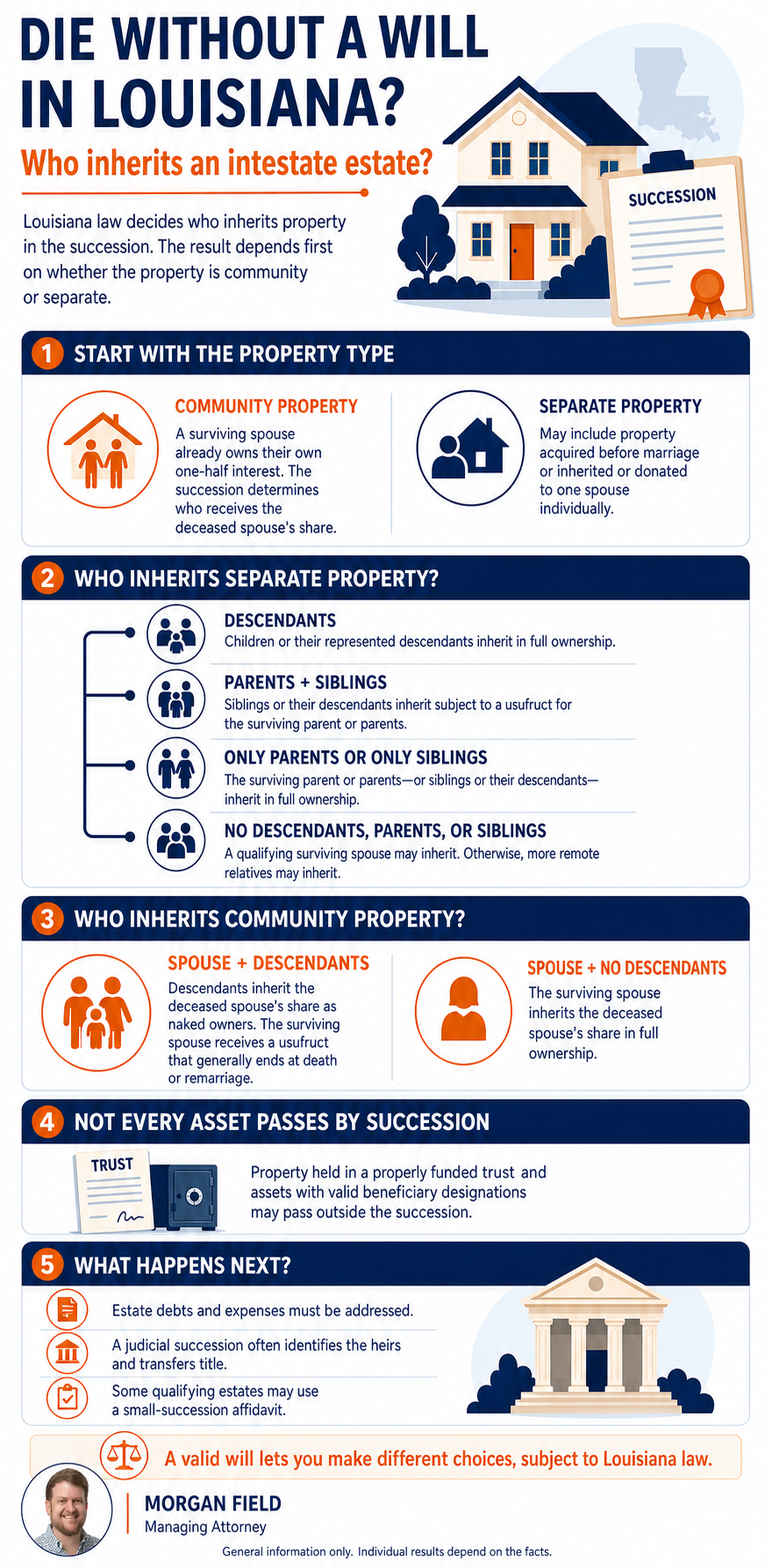
If you die without a will in Louisiana, you are considered to have died intestate. Instead of following instructions contained in a will, Louisiana law determines who inherits the property in your estate.
Intestate succession does not necessarily control every asset you owned. Property held in a properly funded trust and assets with valid beneficiary designations may pass outside the succession. The intestate rules generally apply to property included in your estate that was not otherwise disposed of.
Before determining who inherits, the estate must also address enforceable debts, expenses, and other obligations. The heirs ultimately receive the property remaining after those matters are handled.
Community Property Versus Separate Property
The first major question is whether the decedent’s property was community or separate.
Community property generally includes property acquired during a marriage while the spouses were subject to Louisiana’s community-property regime. Each spouse ordinarily owns an undivided one-half interest in community property.
Separate property may include property acquired before marriage, property inherited by or donated to one spouse individually, and certain property acquired with separate funds. Marriage alone does not make every asset community property.
When a married person dies, the surviving spouse keeps the spouse’s own one-half interest in the community. The succession determines who receives the deceased spouse’s one-half interest. Separate property is distributed under a different set of rules.
Who Inherits Separate Property Without a Will?
Louisiana generally distributes separate property through the following order.
Descendants
If the decedent leaves descendants, the descendants inherit the separate property. Children in the nearest degree generally inherit in equal portions.
If one of the decedent’s children died before the decedent but left descendants, those descendants may inherit by representation through their deceased parent’s branch. This means grandchildren may receive the portion their parent would have inherited.
Parentage issues can become especially important when someone claims the right to inherit as a child but the legal relationship was not established before death. Our article on filiation disputes in Louisiana successions discusses those cases.
Parents and Siblings
If the decedent leaves no descendants but is survived by both a parent and a sibling—or a descendant of a sibling—the siblings or their descendants inherit the separate property subject to a usufruct in favor of the surviving parent or parents. If both parents survive, their usufruct is joint and successive. This rule appears in Louisiana Civil Code article 891.
The siblings therefore do not simply share full ownership with the parents. The siblings or their descendants receive ownership subject to the parents’ usufruct.
If the decedent leaves no descendants or parents, the siblings or their descendants inherit the separate property in full ownership. If the decedent leaves no descendants, siblings, or descendants of siblings, the surviving parent or parents inherit in full ownership. These rules are stated in Louisiana Civil Code article 892.
Surviving Spouse
A surviving spouse does not automatically inherit all of the decedent’s separate property.
Under Louisiana Civil Code article 894, a surviving spouse who is not judicially separated inherits the separate property only when the decedent leaves no descendants, parents, siblings, or descendants of siblings.
If none of those relatives or a qualifying surviving spouse exists, more remote ascendants or collateral relatives may inherit according to their degree of relationship. If no heir exists, the property may ultimately pass to the state.
Who Inherits Community Property Without a Will?
The rules for the decedent’s share of community property depend principally on whether the decedent left descendants and a surviving spouse.
Surviving Spouse and Descendants
When the decedent leaves a surviving spouse and descendants, the descendants inherit the decedent’s share of the community property as naked owners. The surviving spouse receives a usufruct over that share under Louisiana Civil Code article 890.
The usufruct allows the surviving spouse to use and benefit from the property. It generally ends when the surviving spouse dies or remarries.
The descendants do not wait until the usufruct ends to become owners. They receive naked ownership through the succession. When the usufruct ends, their naked ownership ordinarily consolidates into full ownership.
Our articles on what a surviving spouse receives in an intestate Louisiana succession and how usufruct and naked ownership affect a house explain this arrangement in greater detail.
Surviving Spouse but No Descendants
If the decedent leaves a surviving spouse but no descendants, the surviving spouse inherits the decedent’s share of the community property in full ownership under Louisiana Civil Code article 889.
The surviving spouse therefore owns the spouse’s original one-half interest and inherits the decedent’s one-half interest.
Is a Court Succession Always Required?
Many intestate estates require a judicial succession to identify the heirs and place them into possession of estate property. However, some estates may qualify for Louisiana’s small-succession affidavit procedure.
Effective August 1, 2026, the general small-succession value threshold increases to $200,000. Eligibility depends on more than value, so families should review all statutory requirements before relying on an affidavit. Learn more about when a Louisiana family can use a small-succession affidavit.
A Will Lets You Make Different Choices
Dying intestate does not mean the state takes your property. It means Louisiana law supplies an estate plan for you.
That plan may not reflect your preferences. A surviving spouse may receive less than expected, children may become naked owners of the family home, and relatives you would not have selected may inherit. A valid estate plan allows you to make deliberate choices, subject to Louisiana’s community-property and forced-heirship rules.
Field Law Can Help
Field Law can help families determine who inherits when a loved one dies without a will, classify community and separate property, prepare the necessary succession documents, and address disputes involving heirship or ownership. We can also help you create an estate plan designed to avoid an unintended intestate result. Contact Field Law to schedule a consultation.